
The Myth That Makes People Underestimate Ha Giang
One of the biggest myths about the Ha Giang Loop is that it is “just a motorbike ride.”
At first glance, it is easy to understand why people think this way. You rent a motorbike or sit behind an Easy Rider. You follow a road through the mountains. You stop for photos. You sleep in homestays. Then you return to Ha Giang City a few days later.
That sounds like a motorbike trip.
But anyone who has truly experienced the Loop knows that this description misses almost everything that makes it special.
The Ha Giang Loop is not simply a way to move from one viewpoint to another. It is an expedition through one of the most dramatic, culturally rich, and emotionally powerful regions of Vietnam. It is a journey through limestone mountains that have been shaped over hundreds of millions of years, through villages where ethnic minority cultures remain part of daily life, and along a road that was once built by hand through cliffs, valleys, and stone.
That is why so many travelers finish the trip saying the same thing: “This was the highlight of Vietnam.”
Not because the road is easy. Not because every moment is comfortable. But because it feels real, raw, human, and unforgettable.
What Is the Ha Giang Loop?
The Ha Giang Loop is a multi-day road journey through the northernmost mountains of Vietnam. The classic route begins in Ha Giang City and continues through places such as Quan Ba, Yen Minh, Dong Van, Ma Pi Leng Pass, Meo Vac, Mau Due, and Du Gia before returning to Ha Giang.
Depending on the itinerary, travelers usually complete the Loop in three to five days. Some self-ride. Others choose an Easy Rider, sitting behind an experienced local motorbike driver who handles the mountain roads while they focus on the scenery, photography, and cultural experience.
But the word “Loop” can be misleading. It makes the journey sound simple, as if it is just a circular road on a map. In reality, the route crosses high mountain passes, deep valleys, karst plateaus, remote villages, and roads where weather and road conditions can change quickly.
The Loop is not one single attraction. It is a living landscape. The road, the people, the geology, the villages, the weather, the food, the markets, and the quiet moments between famous viewpoints all combine to create the experience.
It Is Not Transportation. It Is an Expedition.
Transportation is about getting from point A to point B.
The Ha Giang Loop is about everything that happens between those points.
On an ordinary trip, the road is something you endure so you can reach the destination. In Ha Giang, the road is the destination. The best memories often happen not at the famous stops, but on the way there: a turn in the road where the whole valley suddenly opens, children waving from a stone house, clouds moving across Ma Pi Leng, a quiet tea stop in a village, or the moment the engine goes silent and you hear only wind moving through the mountains.
That is what makes the Loop feel more like an expedition than a ride. It asks you to slow down, pay attention, and accept that nature is not something you control. The weather may change. The road may be rough. A planned stop may become less important than an unexpected view. Some days are sunny. Some days are foggy. Some mornings begin cold and end warm.
If you approach Ha Giang like a checklist, you may still see beautiful places. But if you approach it like a journey, you will understand why people speak about it differently from almost anywhere else in Vietnam.
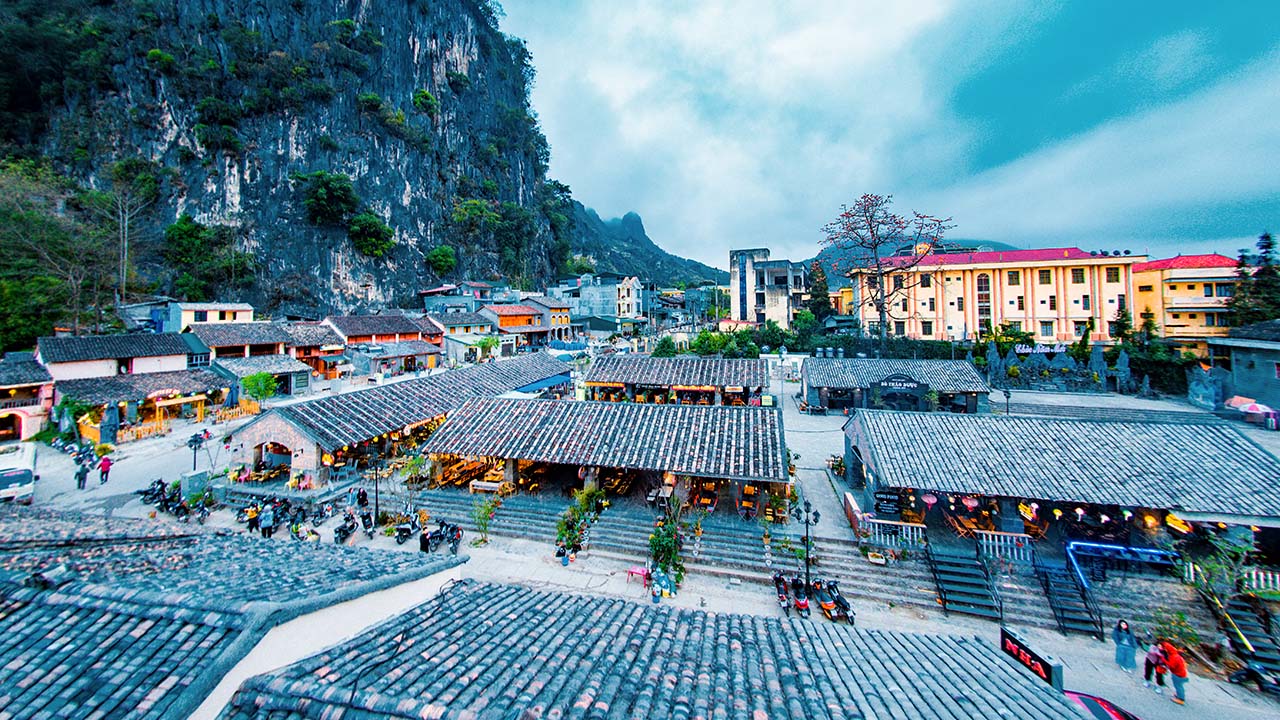
The Landscape Is Older Than Imagination
Part of the Ha Giang Loop passes through the Dong Van Karst Plateau UNESCO Global Geopark, one of the most important geological landscapes in Vietnam. UNESCO describes the region as dominated by limestone formations, with dramatic peaks, deep canyons, and extensive karst systems. Its geological history spans more than 550 million years, beginning in the Cambrian period.
That number is difficult to imagine. Five hundred and fifty million years is far older than human history, older than the first forests, older than dinosaurs, and older than almost everything we usually associate with life on Earth.
When you ride through Ha Giang, you are not just looking at mountains. You are moving through ancient seabeds, uplifted stone, fossil-bearing rock, and landscapes shaped by time on a scale far beyond human life.
UNESCO notes that the geopark contains sedimentary, igneous, and metamorphic rocks, as well as fossil evidence including brachiopods, bivalves, trilobites, corals, conodonts, crinoids, and ancient fish. For travelers, you do not need to understand geology to feel the power of the place. You simply look around and sense that these mountains are not ordinary.
This is one reason the Ha Giang Loop feels so different from many other scenic routes. The landscape does not feel decorative. It feels monumental. The limestone walls rise sharply from valleys. The road clings to cliffs. The Nho Que River winds through deep canyons. Villages sit between stone slopes where farming has always required patience, strength, and adaptation.
A camera can capture the shape of the mountains, but it cannot fully capture their weight. That is something you feel only when you are there.
A Living Cultural Landscape
The Ha Giang Loop is not only about scenery. It is also about people.
The Dong Van Karst Plateau UNESCO Global Geopark is home to 17 ethnic groups, including the Mong, Lo Lo, Pu Mong, Co Lao, Bo Y, Dao, and Tay. UNESCO notes that some of these communities have lived in the region for 500 to 800 years, preserving their languages, customs, crafts, festivals, folk literature, and performing arts.
This matters because Ha Giang is not a stage built for tourists. It is a real home. The stone houses, markets, corn fields, traditional clothing, family-run homestays, and local foods are part of daily life.
As you ride through the Loop, you may see Hmong families working on steep slopes, Tay villages in lower valleys, Dao communities with distinctive clothing traditions, or Lo Lo cultural elements in the far northern districts. You may pass weekly markets where people gather not only to buy and sell, but to meet relatives, exchange news, eat, drink, and maintain community ties.
For many travelers, this human side becomes one of the most memorable parts of the journey. The mountains are spectacular, but the people give the landscape its soul.
A viewpoint can impress you for five minutes. A short conversation with a local family, a shared meal, or a quiet moment in a village can stay with you for years.
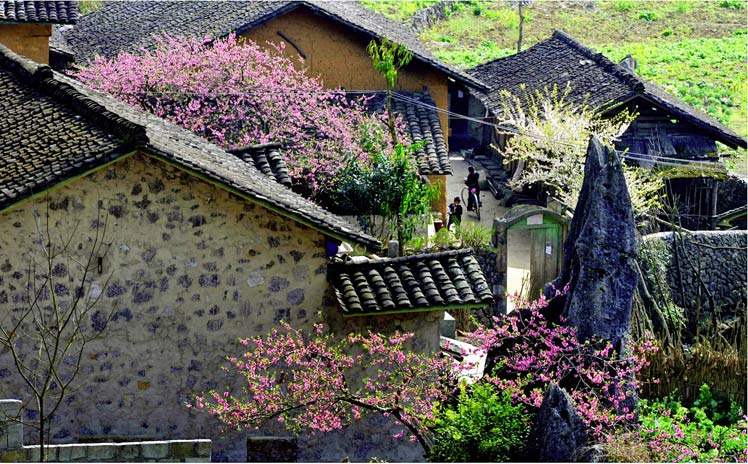
The Road Itself Has a Story
Another reason the Ha Giang Loop is more than a motorbike ride is that the road itself carries history.
The route north from Ha Giang toward Dong Van and Meo Vac is closely associated with the Happiness Road, one of the most meaningful road-building projects in northern Vietnam. According to Vietnam tourism sources, construction began in 1959 and the 185-kilometer road from Ha Giang Town to Meo Vac was completed in March 1965 after years of hardship.
This was not built with the comfort of modern machinery we imagine today. The road passed through harsh limestone terrain. Young volunteers and local residents contributed enormous labor, breaking stone and shaping the route through mountains that had long kept communities isolated. A Tuyen Quang newspaper account notes that fourteen people lost their lives during construction, many others were injured, and the project required more than 2.24 million working days.
When you ride the Ha Giang Loop today, it is easy to focus only on the views. But the road you are enjoying also represents connection: access to schools, healthcare, trade, markets, tourism, and opportunity for communities that once lived with much greater isolation.
That is why the name “Happiness Road” is not just romantic. It reflects what roads can mean in the mountains. A road is not only asphalt. It is possibility.
Why the Loop Feels More Intense Than Other Trips
Many travelers visit Hanoi, Ninh Binh, Ha Long Bay, Hoi An, or Ho Chi Minh City before coming to Ha Giang. Those places can be beautiful, historic, and enjoyable. But Ha Giang often affects people differently.
Part of the reason is physical. You are outside for hours every day. You feel temperature changes directly. You smell rain on the road, smoke from village kitchens, wet soil after a shower, and mountain air in the morning. You are not separated from the landscape by a bus window. You are inside it.
Another reason is emotional. The Loop has rhythm. At first, you may feel excited or nervous. Then the mountains grow larger. The road becomes more dramatic. Your body adjusts to long days outside. You begin to stop checking the time. You start to notice smaller things: the way clouds sit in valleys, the color of corn drying outside houses, how children wave differently from village to village, how quiet the mountains become after sunset.
By the second or third day, many people realize that the Loop is changing their pace. It is no longer about “doing Ha Giang.” It becomes about being there.
That is why the experience can feel so intense. It is scenic, but it is also sensory. It is adventurous, but it is also deeply human.
The Famous Viewpoints Are Only Part of the Story
Yes, the famous stops matter.
Quan Ba Heaven Gate gives you a first taste of the mountains. Dong Van brings you into the high plateau. Ma Pi Leng Pass is one of the most dramatic roads in Vietnam, with cliffs, canyons, and the Nho Que River below. Du Gia offers a softer valley atmosphere, with rice fields, village life, and waterfalls depending on the season.
But the mistake is thinking that the Loop is only a collection of famous viewpoints.
A trip made only of viewpoints can become shallow. You arrive, take a photo, leave, and repeat. After a while, even beautiful places start to blur together.
The real magic of Ha Giang often happens in the spaces between: the slow climb out of a valley, the local lunch you did not expect to love, the coffee shop with a view no one mentioned online, the road where no one else stops, the moment your guide tells you what a village ceremony means, or the evening when the whole group sits together after a long day and realizes how far they have travelled.
This is why choosing the right pace and the right operator matters. A rushed itinerary can show you the map. A thoughtful journey helps you understand the place.
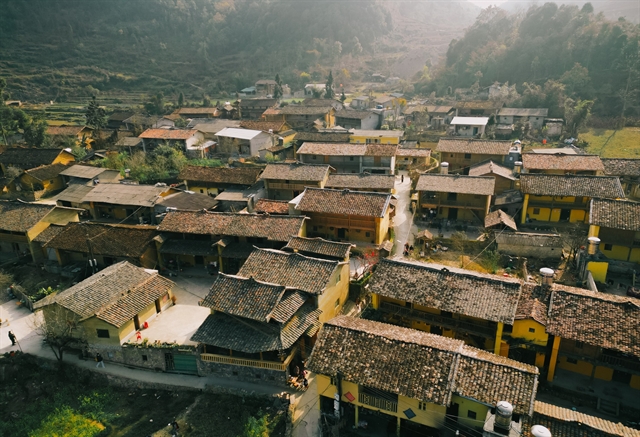
Why Culture Cannot Be Experienced From a Checklist
Travelers often ask what they will “see” on the Ha Giang Loop. That is a fair question. But culture is not something you simply see. It is something you encounter respectfully over time.
You may see traditional clothing at a market. But the clothing is not a costume. It represents identity, skill, community, and history.
You may sleep in a homestay. But a homestay is not just a cheap bed. It is a way to experience local hospitality and village rhythms.
You may eat local food. But food is not only fuel. In the mountains, meals often reflect what can be grown, preserved, carried, or shared in a specific environment.
This is why a good guide makes a huge difference. Without explanation, you may pass through culture as if it is scenery. With a thoughtful local guide, you begin to understand what you are looking at.
Ha Giang is not a museum. It is alive. And because it is alive, it deserves respect. The best travelers do not come only to consume views. They come to learn, listen, and leave with more understanding than they arrived with.
Is the Ha Giang Loop Worth It?
For most travelers, yes. The Ha Giang Loop is absolutely worth it.
But it is worth it for a different reason than many people expect.
It is not worth it only because of the photos. The photos are beautiful, of course. But many places are beautiful.
The Ha Giang Loop is worth it because it combines beauty, adventure, culture, history, and human connection in a way that is rare. It gives travelers the feeling of going somewhere truly different, without needing to leave Vietnam. It feels remote, but welcoming. Challenging, but rewarding. Famous, but still deeply local if experienced the right way.
It is also worth it because it creates memories that are hard to separate from emotion. People do not just remember what they saw. They remember how they felt: small in front of the mountains, free on the road, grateful after a hot meal, quiet at a viewpoint, tired but happy at the end of the day.
That is the difference between a sightseeing trip and an experience.
Who Is the Ha Giang Loop Really For?
The Loop is not only for backpackers. It is not only for experienced motorcyclists. It is not only for young travelers looking for adventure.
The Ha Giang Loop can be for many types of people, as long as expectations are realistic.
It is for travelers who want landscapes that feel bigger than ordinary life. It is for people who enjoy road journeys, mountain air, local culture, and days that unfold slowly. It is for photographers, couples, solo travelers, small groups of friends, and anyone who wants to experience a side of Vietnam that feels very different from the major tourist cities.
If you are not confident riding yourself, an Easy Rider makes the journey accessible. You do not need to be brave. You need to be open. Open to long days outside, changing weather, simple mountain life, and the occasional discomfort that comes with real travel.
The Loop may not be for someone who wants luxury at every moment, perfect weather every day, or a predictable city-style schedule. Ha Giang is beautiful precisely because it is still wild in many ways. That is part of the charm.
Why People Call It the Highlight of Vietnam
Vietnam has many famous destinations. Ha Long Bay has limestone islands. Hoi An has lanterns. Ninh Binh has rivers and karst towers. Sapa has terraces. Ho Chi Minh City has energy. Hanoi has history and chaos.
So why does Ha Giang so often become the highlight?
Because it combines several kinds of travel into one journey.
It is a landscape trip, because the mountains are extraordinary.
It is a cultural trip, because ethnic minority communities are part of everyday life along the route.
It is an adventure trip, because the road is challenging and the weather can change.
It is a human trip, because the people you travel with and meet along the way become part of the story.
It is also a slow travel trip, even though you are moving every day. You cover distance, but the best parts require attention. You have to look, listen, stop, talk, and allow the mountains to set the pace.
That combination is rare. Many destinations are beautiful. Fewer destinations make travelers feel transformed.
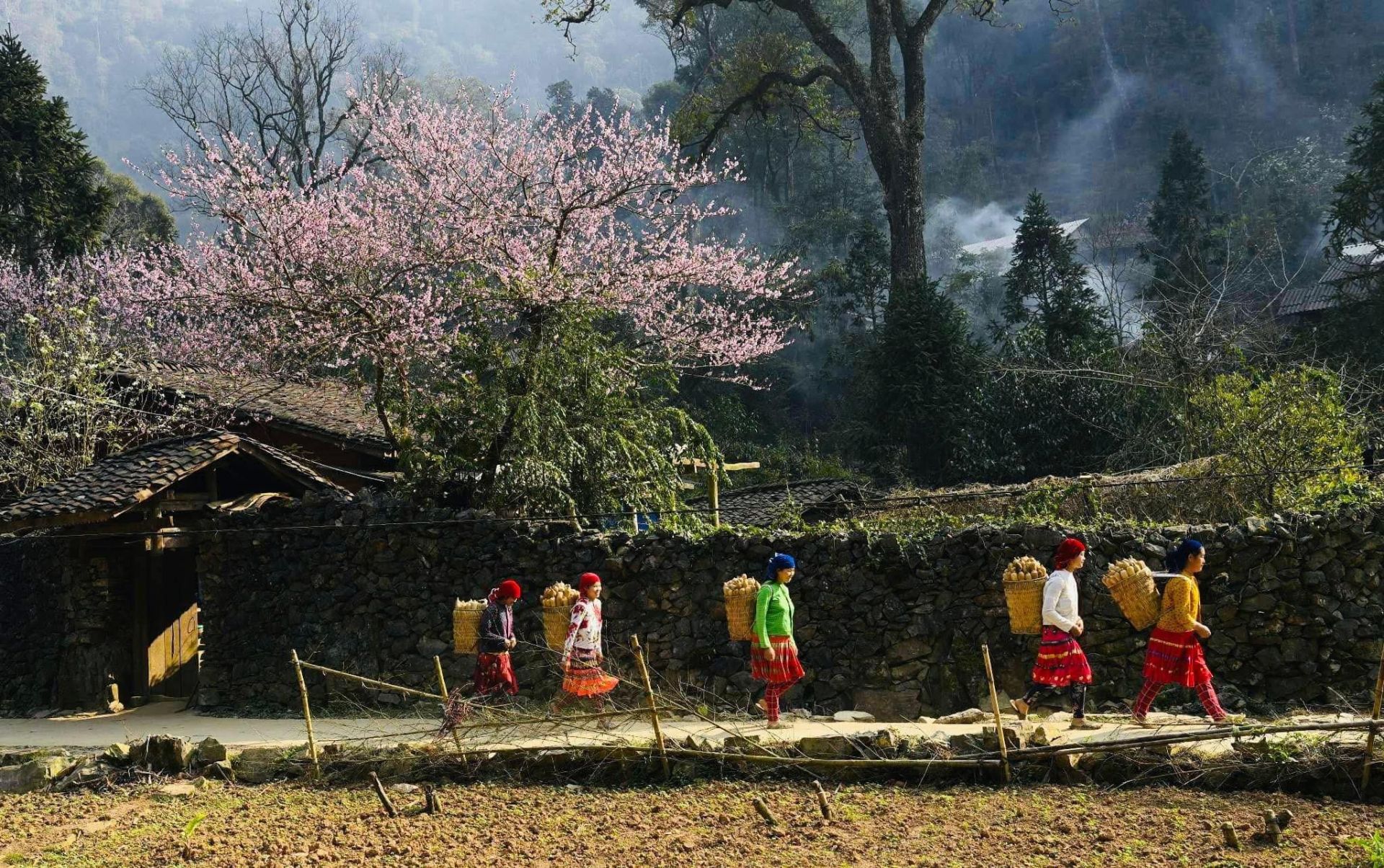
Why the Right Group Changes Everything
Because the Ha Giang Loop is not just a motorbike ride, the group you travel with matters enormously.
A large, rushed group can turn the Loop into a series of stops and waiting times. A small, thoughtful group can turn it into a shared journey.
With the right group, you have time to enjoy the view without feeling pushed. You can stop at smaller places that big groups cannot manage. Your guide can answer questions, explain culture, adjust the route, and help you notice things you would otherwise miss.
The right group does not only affect comfort. It affects meaning. It decides whether Ha Giang feels like a tour you joined or a journey you lived.
How Ha Giang Loopers Sees the Journey
At Ha Giang Loopers, we do not see the Loop as a product made of viewpoints.
We see it as our home.
That changes how we design the experience. We believe small groups create better memories. We believe safety comes before schedules. We believe good accommodation matters after a long day on mountain roads. We believe guides should not only drive, but also help guests understand the landscapes and cultures they are passing through.
We also believe that the best moments cannot always be planned. Sometimes the right stop is not the famous one. Sometimes the best photo is not at the viewpoint. Sometimes the most meaningful memory is a conversation, a shared meal, or five quiet minutes watching clouds move over the mountains.
That is why we focus on quality, local knowledge, and a pace that allows the journey to breathe.
Anyone can take you around the Loop. The real question is whether they help you experience it.
Final Thoughts: The Loop Is the Destination
The biggest myth about the Ha Giang Loop is that it is just another motorbike ride.
It is not.
It is a road through ancient stone, remote villages, living cultures, mountain weather, and human stories. It is a journey built on history and shaped by the people who call these mountains home.
If you treat it like transportation, you may still enjoy the views.
If you treat it like an expedition, you may understand why it becomes unforgettable.
The Ha Giang Loop is not about checking places off a list. It is about entering a landscape slowly enough to feel it.
That is why people come for the motorbike ride, but leave remembering much more: the mountains, the villages, the food, the road, the people, the weather, the silence, the laughter, and the strange feeling that for a few days, they were part of something far bigger than a tour.
That is the real Ha Giang Loop.


